
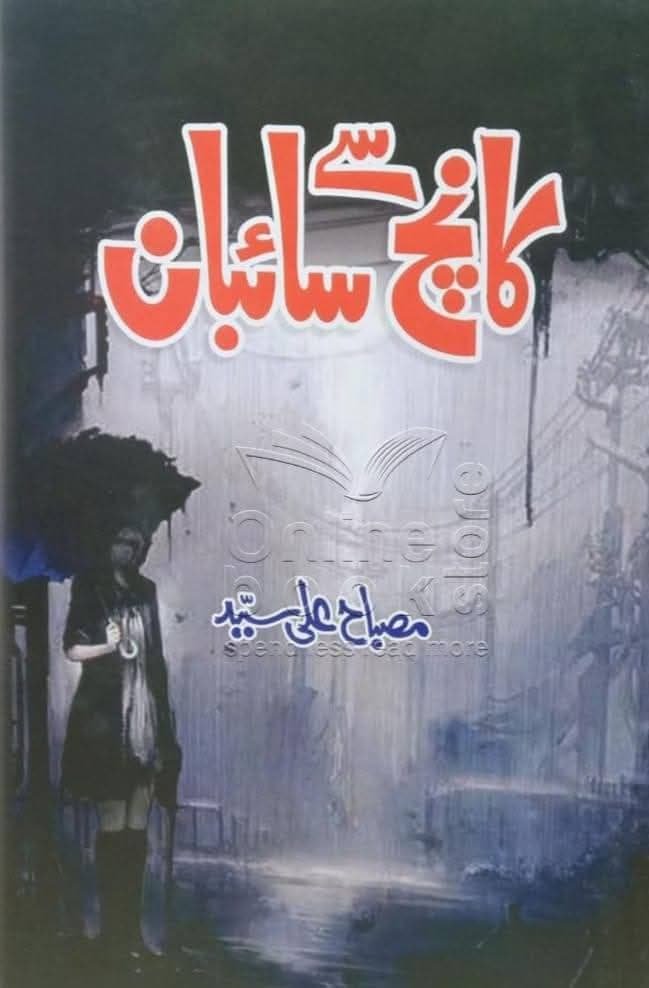
When the Marriage Cracks, the Daughter Feels It: Reading Kaanch Se Saiban
A glass canopy looks like shelter, yet it protects only until something strikes it. The title Kaanch Se Saiban (“a canopy of glass”) points to that fragility. It suggests a home that appears to cover the people inside it but can shatter under pressure from within. In Kaanch Se Saiban by Misbah Ali Syed, that pressure is felt first by a married couple and then, years later, by their daughter.
This Urdu social novel appeared in Kiran Digest from August 2020 to January 2021. It runs to six episodes and 125 pages and is a complete story. It combines a university setting, an after-marriage storyline, and a family-centred plot, and its main strength is that it follows one household across two generations.
A Proposal Pressed Too Hard, a Marriage Tested Too Soon
The first storyline begins on a university campus. Haim, a fellow student, develops strong feelings for Radaba. By the novel’s account he does not win her over quickly. He insists on marriage repeatedly, and eventually they marry.
The novel’s attention then moves from courtship to what comes after, and this is where it becomes more than a campus romance. Many Urdu stories end at the wedding. Kaanch Se Saiban treats the wedding as the start of the real test. The couple’s married life runs into serious trouble, much of it caused by unnecessary conflicts within the joint family.
The word “unnecessary” matters here. The novel does not describe a marriage destroyed by one great betrayal. It describes one worn down by friction that never needed to exist, which is arguably more familiar to readers. Joint-family life can offer support, but when interference, tension, and misunderstanding take over, a young couple has little private space in which to build trust.
Ego as a Second Household Member
The novel does not place all the blame on the extended family. Radaba’s ego, stubbornness, and rigid attitude are presented as real contributors to the damage. This keeps the story from becoming a simple tale of a good couple and a bad family. Outside interference and personal inflexibility feed each other. A spouse unwilling to bend gives the surrounding conflict more to work with, and a family that keeps stirring trouble makes bending harder.
This is a realistic way to treat marital breakdown. Readers looking for an after-marriage Urdu novel that goes beyond romance will find a story in which the problem is a pattern of attitudes, not a single villain.
Growing Up in the Aftermath
The second storyline shifts to Minhal, the daughter of Radaba and Haim. She grows up in her grandmother’s house, and the novel makes clear that her upbringing is shaped by the family’s troubled atmosphere. This is the part of the book that gives the title its fuller meaning. A glass canopy fails everyone beneath it, and the child is the one with the least power to repair it.
Through Minhal, the novel looks at the emotional and social difficulties of children from broken families. The point is not that her parents’ choices end with them. Their quarrels, their pride, and the family’s habits of conflict continue into the next generation and shape the home she has to live in.
Minhal is deeply affected by that atmosphere. The novel treats her unease as a real consequence of the environment around her, not as a passing mood. An unstable household affects a young person’s sense of safety and belonging, and a university-age girl is still learning how to trust people.
A Quiet Warning About Boundaries
One of the novel’s more serious threads concerns one of Minhal’s cousins, who has inappropriate intentions toward her. It adds a difficult layer to her circumstances, and it deserves careful reading.
The inclusion of this detail says something about the novel’s social awareness. A young woman’s safety is not guaranteed simply because she lives among relatives. Family closeness can hide behaviour that should never be excused, and a home already strained by conflict may be less alert to the risks one of its members faces. The novel raises the subject without reducing it to a sensational plot device. It acknowledges that a girl’s personal boundaries need protection even, and sometimes especially, within the family.
Two Generations, One Pattern
The strongest structural choice in Kaanch Se Saiban is the pairing of the two storylines. Radaba and Haim show how a marriage can be damaged by ego, stubbornness, and interference. Minhal shows what that damage looks like years later from a child’s perspective. The novel’s summary of its own approach is that it draws a complete outline of domestic problems, their effects on close relationships, and their outcome across past and present.
Read this way, the parents’ story and the daughter’s story are two parts of one argument: decisions made by adults at the centre of a household have consequences for the people who inherit that household. The novel makes this point through the structure of its plot, not through lectures, and that restraint helps it.
Minhal and Ziyaj: A Gentler Thread
Minhal’s university life includes Ziyaj, a fellow student. They share a friendly relationship, and it provides a lighter counterweight to the heavier material at home. Their story is not meant to compete with the novel’s social concerns. It offers a different kind of relationship, built on friendship, set against the strained relationships around Minhal.
The novel gives their story a happy ending. The details are best left for readers to discover, but the outcome matters to the book’s overall tone. Despite its serious subjects, the novel is told in a relatively light-hearted style, and the ending fits that approach.
Style and Accessibility
The light-hearted narration is part of the novel’s character. The book deals with marital conflict, family interference, and a young woman’s vulnerability, yet the telling stays accessible. That makes it suitable for readers who enjoy digest-style fiction and want social themes without a heavy, grim tone. At 125 pages across six episodes, it is also a compact read for anyone who prefers a complete story to a long serial.
What Remains After the Glass Settles
Kaanch Se Saiban is a reminder that homes are built from attitudes as much as from walls. Pride that refuses to bend, interference that refuses to stop, and a family that does not protect its youngest members can turn a shelter into a fragile one. The novel’s hopeful note, Minhal and Ziyaj’s happy ending, suggests that the next generation does not have to repeat the previous one’s story, even when it inherits the damage.
For readers of Misbah Ali Syed’s novels, or anyone searching for a family-based Urdu novel that looks at what happens after the wedding and after the quarrel, this is a story worth considering.
Read PDF Online
Kaanch Se Saiban by Misbah Ali Syed