
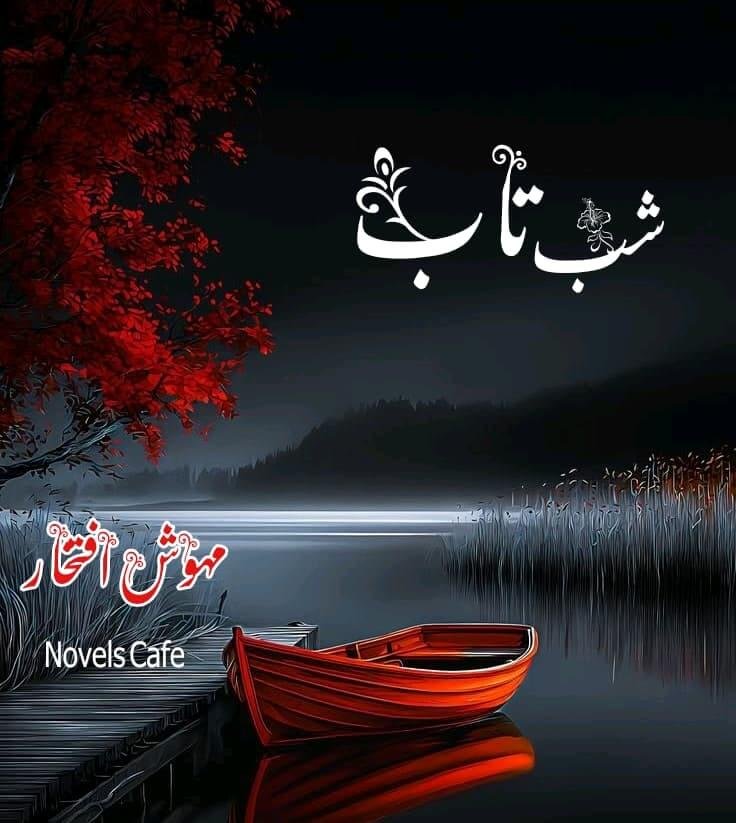
A Village Rumour, a Pir’s Daughter and an ASP Who Speaks His Mind
In a small community, a rumour can outlive the people who started it, and the person it targets may carry it long after everyone has forgotten how it began. That idea runs through Shabtab by Mehwish Iftikhar, a novel that appeared in four episodes of Shuaa Digest between March and June 2018 and runs to roughly 160 pages. It is a romance, but the romance grows out of an old injustice that has never been settled.
A Rumour Older Than the Romance
Many romantic Urdu novels begin with two people meeting. Shab e tab begins, in effect, with a wrong that was done long before the hero arrives. Years earlier, Pir Sahib’s elder daughter-in-law linked the name of his daughter Zarnab with the son of Kabir Singh, a Sikh villager. She did it for her own interests. Kabir Singh was driven out of the village, and the accusation settled over the surrounding area.
What the author does well here is treat the rumour as something that keeps working on the present. Years later it is still the main obstacle to Zarnab’s marriage. The novel does not need to restage the original incident to show this. The consequences, still unresolved in the present, carry the weight
Kabir Singh and the Pir’s Kindness: The Story Told in the Past
The second timeline belongs to Kabir Singh, who lives in the village with his wife and son and holds Syed Nazar Hussain Shah in deep respect for his kindness. The novel treats him as a man shaped by that respect, not as a bystander, and it lets his story move gradually toward its own ending.
The setting is also where the novel’s religious dimension comes from. A Sikh villager admires a Muslim Pir, and the Pir’s goodness is what earns that admiration. The reader can feel how much the later expulsion costs. Because the past and present threads run in parallel, the reader understands the present only by understanding what happened earlier. The two timelines are what the novel’s structure rests on.
Zarnab Shah, Twenty-Seven and Still Carrying Someone Else’s Lie
Zarnab is twenty-seven, and she has lived with the accusation for years. Mehwish Iftikhar describes her as innocent, determined and dignified. The three qualities together make a believable portrait. Innocence is her relation to the original charge, and dignity is how she bears it. Determination suggests she has not simply accepted what the village decided about her.
She is also the Pir’s daughter, which places her somewhere between privilege and vulnerability. Her family’s standing gave the rumour its weight, and the people closest to her gave it its source. The novel does not make her a passive victim, but it never lets the reader forget how unfair her position is.
An ASP Who Says What He Feels
Saif Ali Jang arrives as an ASP posted to the same village. He is commanding and principled, and, unusually for a hero of this type, he knows how to express his emotions. That last quality sets him apart from the silent, brooding heroes some readers will expect. His authority comes from his post and his personality, and the novel does not pair it with emotional reticence.
His dialogue is one of the novel’s main pleasures. It is sharp and lively, and at times deliberately ambiguous, which keeps the reader attentive to what he means as well as what he says. Much of the character’s appeal comes from this language, which is a good example of how Iftikhar builds interest through speech instead of through descriptive passages about a character’s greatness.
Brothers, a Cousin and the Cost of Self-Interest
Saif is defined partly by contrast. Zarnab’s brothers are self-interested, and her cousin Hashim is extravagant. These are the people who make her life harder, and Saif’s firmness stands out sharply against them. His encounters with these men show his principles under pressure.
The family conflict also echoes the old accusation. The rumour began with the elder daughter-in-law’s selfish interest, and the present-day pressures on Zarnab also come from people close to her who look after their own interests first. The novel’s concern with distrust, power and jealousy therefore feels connected across both time periods. Hostility in Shabtab rarely comes from strangers. It comes from relatives.
Why Mehwish Iftikhar’s Emotional Range Suits This Story
Mehwish Iftikhar is known for her detailed handling of emotions: love and hatred, sacrifice and long-standing enmity, devotion and distrust. Shab e tab gives her room to work across that whole range. Devotion shows in Kabir Singh’s respect for the Pir. Jealousy and self-interest show in the family. Love shows in the central relationship of Saif Ali Jang and Zarnab Shah.
A reader coming to Mehwish Iftikhar novels for the first time will find in this one a good sample of what her readers value. The emotions are not treated as decoration. They drive the plot, and the careful choice of words gives each of them room.
A Resolution Worth Waiting Four Episodes For
Serialised novels depend on holding a reader’s interest from one issue to the next, and the four-part structure of Shab e tab suits a story where the past has to be answered before the present can be settled. The ending is happy, and it feels satisfying because the novel has taken the injustice seriously throughout. The rumour, the family’s greed and Kabir Singh’s story all need an answer, and the ending gives one.
For readers who enjoy romantic Urdu novels with a moral and emotional centre, the Shabtab Urdu novel is worth reading in full. It is a compact story that connects romance, faith and two timelines more carefully than its length would suggest. Readers who have already finished it are welcome to share their views on how the past and present storylines come together.
Read PDF Online
Shab E Taab By Mehwish Iftikhar