
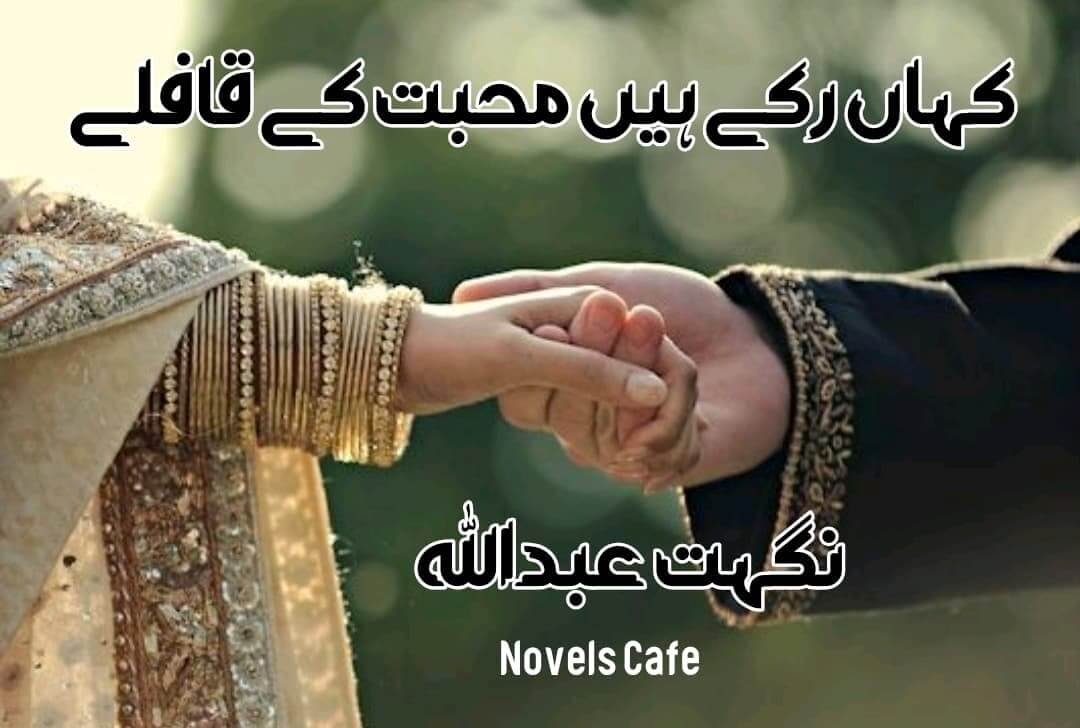
Novel: Kahan Rukay Hain Mohabbat k Qaflay
Writer: Nighat Abdullah
Published in: Shuaa Digest May1995
Status: Complete Novel
Pages:41
Genre: Hero Boss based| Romantic Love Story 💕| Family Based
File Format: Pdf (Online)
When a Family’s Pain Decides a Heart’s Direction
There is a particular kind of cruelty in a proposal that arrives from the very household that has already hurt someone you love. In Nighat Abdullah’s Kahan Rukay Hain Mohabbat K Qaflay, first published in Shuaa Digest in May 1995, the youngest sister’s marriage prospects are tied up with her elder sister’s unhappiness. Everything that follows grows out of that uneasy fact.
The novel belongs to the tradition of romantic Urdu novels in which love is never a private matter. It has to make its way through obligations, expectations and the quiet pressure of people who depend on you.
The Youngest Sister Who Watches and Carries
Ayesha is the youngest of three sisters, and the novel makes that position matter. Both of her elder sisters are already married, so she stands at the edge of a household that has mostly moved on, still close enough to feel every tremor in it. The youngest child in a family is often seen as the one with the most freedom. Ayesha’s story suggests the opposite. Having watched her sisters’ lives unfold, she cannot treat her own future as separate from theirs.
One of those sisters is not happy in her marriage. Her in-laws do not treat her well, and this single circumstance shapes the rest of the story. Ayesha does not need to be told that marriage can be a place of hardship, because she has seen it in her own family. That knowledge gives her later choices their weight.
A Proposal That Cannot Be Read as Simply Good News
In most family stories, a proposal is a celebration. Here it is a complication. The in-laws who have treated Ayesha’s sister poorly later ask for Ayesha herself, as a bride for their younger son.
The situation is layered. A family might see such a match as a way of strengthening ties, and the novel leaves room for that reading. But for Ayesha and her sister the proposal carries a very different emotional charge. It asks the younger sister to step into the same household network where the elder has suffered. The novel gains much of its tension from this double meaning. The same offer can look like closeness or like pressure, depending on who is looking at it and what they have endured.
The Boss Who Becomes Something More
Against this domestic background, the story places Hammad Hassan, Ayesha’s boss. The boss-employee romance is a familiar and much-loved pattern in Urdu fiction, and its appeal here lies in contrast. Ayesha’s home is a place of obligation and worry. Her workplace is where she is seen as a capable person in her own right, and it is there that Hammad’s feelings take shape.
The novel presents his affection as gradual. He begins by liking her and moves, in time, toward arranging their marriage. This slow development matters because it makes his later steps believable as more than a sudden impulse. When he acts, he is acting on something that has had time to grow. The story does not tell us everything that goes on in his mind, and a reviewer should resist filling in what the text leaves open. What can be said is that his intentions are serious and that they lead directly into the story’s central conflict.
The Crisis That Rewrites Everything
Just as Ayesha’s personal happiness seems within reach, her family’s situation worsens sharply. Her married sister is thrown out of her marital home, and her children are taken away from her. The earlier unhappiness becomes a full-scale crisis.
This is the turning point of the novel, and it is built on a painful asymmetry. Ayesha’s sister has lost her home and her children, which is as much as a mother can lose. Whatever Ayesha wants for herself, it is hard to weigh against that. The novel does not need to make the choice look easy or difficult in a dramatic way. The facts alone create the pressure.
Ayesha feels compelled to agree to marry her sister’s brother-in-law. The word “compelled” is the key to reading her decision. This is not a woman who has stopped caring about love. It is a woman who has judged, under painful circumstances, that her sister’s suffering outweighs her own hopes.
Two Kinds of Love, Pulling in Opposite Directions
The heart of the novel is the contest between two kinds of love. One is romantic, represented by Hammad and the future he has begun to plan. The other is familial, represented by an elder sister in distress. Neither is presented as false, and that is what makes the conflict real.
Ayesha’s decision is a sacrifice, but it is not a simple one. It asks her to set aside what she may want most for the sake of someone she cannot abandon. Readers who enjoy emotional family drama will recognise the shape of this dilemma, in which the right choice and the happy choice do not seem to coincide.
The novel also treats Hammad’s position with some delicacy. He has taken steps toward marriage, so Ayesha’s decision affects him as well. The story holds all three people in its attention: Ayesha, her sister and the man who had hoped to build a life with her.
Why the Happy Ending Feels Earned
The novel concludes with an ending that is happy and satisfying. This is worth noting because a story so concerned with sacrifice could easily have ended in loss. Instead, it rewards the reader’s patience.
A happy ending feels most satisfying when the story has taken its sorrows seriously. Here the earlier pain is neither skipped nor trivialised. Ayesha’s difficult decision, her sister’s crisis and the broken expectations of romance all have weight, and so the resolution reads as relief rather than convenience. For readers of classic Shuaa Digest fiction, this balance between sorrow and consolation is a large part of the appeal.
What Gives This 1995 Story Its Lasting Warmth
Several things make Kahan Rukay Hain Mohabbat K Qaflay worth attention today.
- A believable family bind. The conflict comes from circumstances ordinary enough to recognise: marriage, in-laws, sisterly loyalty and responsibility.
- A romance that develops slowly. Hammad’s growing feelings give the love story a natural pace rather than a rushed one.
- A moral dilemma without villains in the foreground. The pressure on Ayesha comes largely from the situation itself, which makes her choice more affecting.
- An ending that respects the journey. The happiness at the close is made meaningful by the difficulty that precedes it.
Readers who like boss-based romance, family drama and stories of emotional sacrifice will find all three woven together here.
The Caravans That Keep Moving
The title asks where the caravans of love have stopped, and the story answers that they have not. Ayesha’s love and her loyalty to her sister are not simple rivals in which one must die for the other to live. They travel together, through hardship and compromise, toward a resolution that honours both.
Nighat Abdullah’s novel is ultimately about a young woman who learns that her heart belongs to more than one person, and that the people she loves are not always asking for the same things. That is a very old human problem, and the novel’s warmth lies in showing that, however painful the road, it can still arrive somewhere kind.