
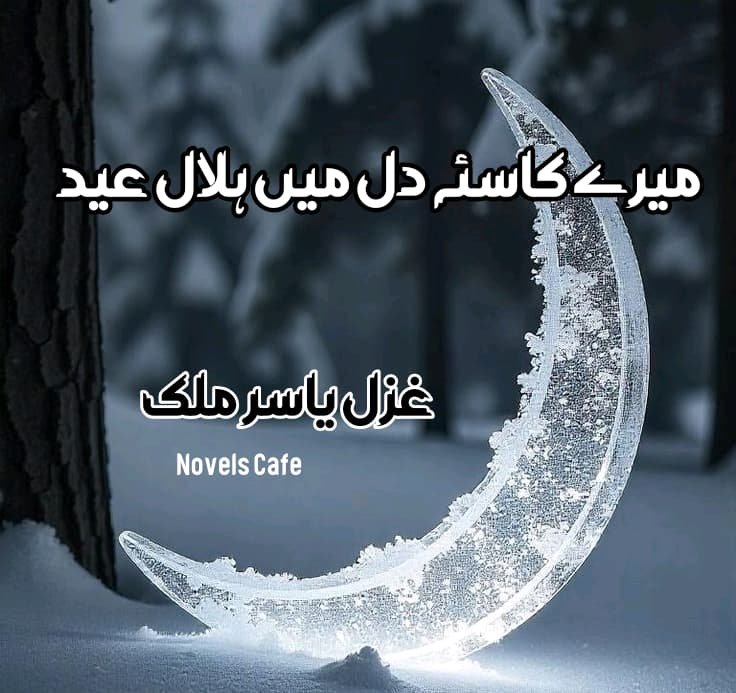
A Crescent Over a Changing Life
Some novels announce their mood in the title alone. Mere Kasa-e-Dil Mein Hilal-e-Eid by Ghazal Yasir Malik is one of them. Published in the December 2003 issue of Khwateen Digest, this complete romantic and family-based story follows a young woman whose life is reshaped by loss, relocation, and an unlikely meeting. It is a compact novel, and its appeal lies in how it builds an emotional journey out a few well-chosen turning points.
A Title That Sets the Mood
The title translates roughly as “the Eid crescent in the bowl of my heart.” In Urdu poetry, the kasa (bowl) often stands for a heart that is empty and waiting, and the hilal-e-Eid (Eid moon) is the thin crescent people search the sky for after a long stretch of fasting. Together the images suggest longing that ends in joy.
That reading is an interpretation, not a plot point, but it fits the novel’s promised arc: a story of waiting and changing circumstances that closes on a happy ending. For readers who like to know the emotional temperature of a book before starting, the title is a reliable guide.
An Engagement Made Before Choice Was Possible
The heroine, Fabiha, has been engaged since childhood to her cousin’s son, who is a doctor. Childhood engagements within the extended family are a familiar feature of Urdu domestic fiction, and they rest on a particular idea of security: the future is settled long before the person living it has had a say.
What makes this setup interesting is the tension it creates. A match arranged by elders is stable on paper, and that stability is exactly what a novel can test. The supplied story information does not tell us how the engagement fares or what role the doctor plays later, so it would be unfair to guess. It is enough to say that the engagement gives Fabiha an established place in a family network, and the story then moves her away from it.
When Loss Redraws the Map
The turning point comes with the death of Fabiha’s father. Afterward, her mother takes her to another city, and Fabiha’s life enters what the story describes as a new phase.
Family dramas often work this way. A bereavement breaks the routine, and the practical decisions that follow, such as where to live and whose household to depend on, push characters into situations they would never have chosen. Fabiha’s move places her among unfamiliar surroundings and unfamiliar people, which is fertile ground for a romance. A heroine who is both grieving and newly settled is more open to unexpected encounters, and more vulnerable to them.
The Hawk and the Unhappy First Meeting
The heroine’s first meeting with the hero, Shaktal Hassan, is not a happy one. In an incident, his hawk injures Fabiha.
It is a distinctive opening for a romance. Many love stories begin with a polite introduction or a shared glance. Here the hero’s first impact on the heroine is, quite literally, painful. A pet bird of prey is an unusual detail for a digest novel, and it gives the hero a memorable identity before he has said anything.
The encounter also fits an old and durable pattern in love stories, the rocky first meeting that leaves two people with an awkward bond. Because the hawk belongs to Shaktal Hassan, the injury is tied to him from the start. Whether that creates guilt, friction, or curiosity is something the novel itself answers. The story information calls the moment an interesting twist, and as a narrative device it does its job: it links two strangers at once and makes the reader curious about what comes next.
Fabiha and Shaktal Hassan: What the Pairing Promises
The central relationship follows from that first meeting. The novel traces how the circumstances around Fabiha and Shaktal Hassan change and how their story develops, and the early setup suggests a slow-moving connection rather than instant romance.
Consider what each character brings. Fabiha arrives carrying a childhood engagement and the weight of a recent loss. Shaktal Hassan enters through an accident, with a hawk that introduces him dramatically. The two begin from very different places, and the pull of the story is in watching those places move closer. Readers who enjoy relationships that grow out of friction and circumstance, rather than out of convenience, will find the premise promising.
Why the Family Setting Matters
The novel is labeled both a romantic love story and a family-based story, and the two work together. A father’s death, a mother’s decision to relocate, and an engagement within the extended family are all family matters before they are romantic ones. The love story is shaped by these obligations, not set apart from them.
This is one of the quieter strengths of the digest tradition. Romance in these stories rarely happens in isolation. It runs through households, expectations, and relationships that predate the lovers. Even from the limited details provided, it is clear that Fabiha’s choices will be tied to her family’s history, which gives the romance more weight than a simple meeting of two hearts.
A December 2003 Digest Novel
The novel appeared in Khwateen Digest in December 2003, during a period when monthly women’s digests were among the most popular reading in Urdu-speaking homes. Complete novels of moderate length were a staple of these issues, written to be read in one sitting or over a few evenings, and to deliver a satisfying emotional arc without sprawling subplots.
Mere Kasa-e-Dil Mein Hilal-e-Eid belongs to that tradition. It is described as a short, engaging novel with a happy ending, which suits readers who want a self-contained romance rather than a long saga. Page count is not specified, but the format and description point to a quick, easy read.
Who Will Enjoy This Novel
This story will suit readers who enjoy:
- Classic Urdu digest romance with family at its center
- Love stories that begin with an awkward or painful first encounter
- Heroines facing a major change in circumstances
- Complete, compact novels with a reassuring ending
Readers looking for experimental structure or heavy psychological drama may find it gentler than they want. For those who value warmth, emotional clarity, and a hopeful resolution, it promises exactly that.
Where the Crescent Leaves the Reader
The Eid crescent is a small sliver of light that signals the end of waiting. That is a fitting image for a novel in which a young woman loses her father, leaves her home, and meets a man by way of an injury, all before the story has really begun. What follows, as the novel promises, is a journey toward a happy ending.
Ghazal Yasir Malik’s story works from familiar ingredients: an early engagement, a family loss, a new city, and a memorable first meeting. Its appeal comes from how those ingredients are arranged and from the hope carried in its title. For readers who like to open a book knowing it will end well, Mere Kasa-e-Dil Mein Hilal-e-Eid is a gentle and rewarding choice.