
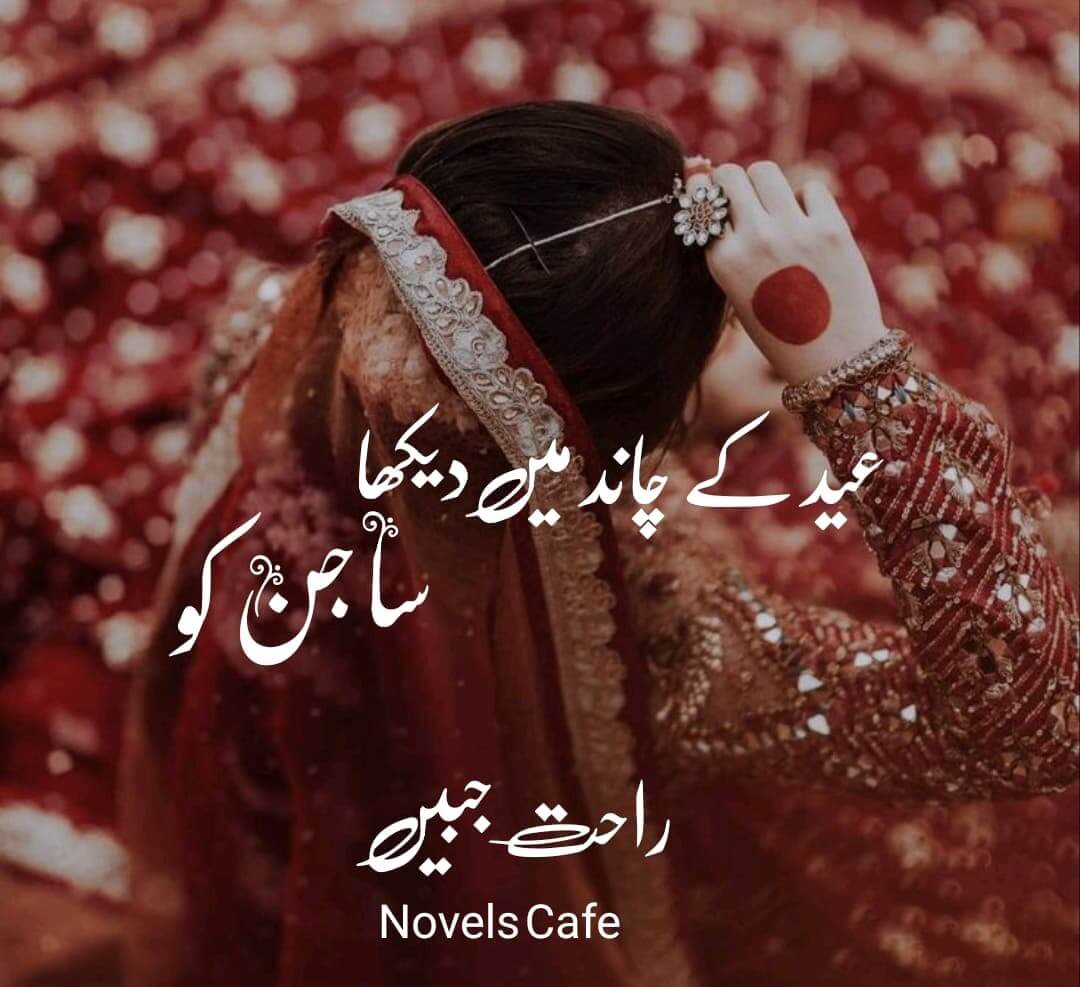
Eid K Chand Mai Dekha Sajan Ko by Rahat Jabeen: A Novel About Finding Home After Heartbreak
Some stories open with celebration. Others open with an ache and let the celebration arrive late. Eid K Chand Mai Dekha Sajan Ko by Rahat Jabeen belongs to the second kind. First published in Khwatan Digest in December 2002, this romantic family novel follows a young woman whose early life has been marked by loss, and who slowly discovers that belonging can be found in a place she never expected.
The title itself carries a tender image. Eid is the night everyone searches the sky for a thin crescent, and in the old romantic imagination, a beloved’s face is glimpsed in that same moon. Reading the title this way is our interpretation, but it suits a story about hope arriving quietly, after a long wait.
A Girl Who Has Known Uncertainty Since Childhood
Saba’s troubles begin early. Her parents are divorced, and she grows up with her mother in her maternal uncle’s house. It is a roof over their heads and a family of sorts, but it is not quite her own home. The story suggests a childhood spent in someone else’s space, which can shape a person’s sense of security in ways that are hard to name.
Her life seems to be moving toward stability when she is engaged to Basit. Then Basit goes abroad and marries someone else there. We are told only this much, and the novel’s strength, as the summary presents it, lies in what that broken promise means for Saba, not in the details of how it happened.
When the Past Returns, Child in Hand
After some time, Basit comes back with a child and tries to win Saba back. What makes this development so uncomfortable is how little is simple about it. He is not a stranger from her past but a man tied to an old promise, and his return reopens a wound she has presumably tried to close. The novel places Saba in an emotionally tangled position, one where the past does not stay in the past.
We should be careful here. The available information does not tell us how Saba responds to him, or what lies behind his marriage and his child, so those questions are best left to the novel itself. What we can say is that his return becomes the pressure that changes the direction of her life.
A Mother’s Decision
Seeing the situation, Saba’s mother sends her to live at her father’s house. It is a significant moment. A daughter who has grown up in her mother’s world, shaped by divorce, is now sent toward the other side of her family. Whether it feels like relief, uncertainty or both is something only the novel can answer, but the move marks a clear turning point. Saba leaves a place filled with complications and enters one that is entirely unfamiliar.
A House with Many Voices: The Joint Family at the Heart of the Story
What Saba finds at her father’s house is a big, warm, affectionate joint family. After the uncertainty of her earlier life, this is where the novel’s emotional contrast comes alive.
Joint family settings have always held a special place in Urdu fiction, especially in the digest tradition. They offer a world where a house is never quiet, where relatives share the rhythms of the day, and where no one is quite alone. For a character like Saba, who has lived with separation and disappointment, such an environment is more than a backdrop. It is a quiet answer to everything that has hurt her.
It is also worth noticing how the setting works as storytelling. A crowded, loving household offers a natural space for relationships to grow slowly, through shared routines and everyday closeness instead of dramatic grand gestures. Rahat Jabeen is credited with portraying this family atmosphere beautifully, and it is easy to see why readers who enjoy domestic warmth keep returning to stories like this one.
Mehrooz and the Slow Unfolding of Love
It is in this household that Saba meets Mehrooz. Their growing closeness gradually becomes a lovely romantic relationship, and this is where the story takes what the summary calls a beautiful turn.
Without inventing scenes, we can still appreciate what Mehrooz represents within the structure of the novel. Basit’s story is one of broken promises and complicated return. Mehrooz’s arrival offers a different kind of connection, one that grows within the safety of family life instead of in the shadow of a past engagement. Seen this way, the romance does not just add a love interest. It gives Saba’s story a second beginning.
The gentleness of the romance is another part of its appeal. The novel is described as capturing soft romantic feelings, which suits the digest style of storytelling: affection that grows through closeness, not spectacle.
The Quiet Themes Beneath the Romance
Several ideas seem to run through the novel.
Belonging. Saba moves from a household where she is a guest of circumstance to one where she is part of a larger whole. The story seems to ask what it takes to feel at home.
Second chances. Basit’s return offers one kind of second chance, an attempt to repair what was broken. Meeting Mehrooz offers another, the chance to begin something new. Contrasting these two paths is one of the more interesting readings the story invites.
Family as shelter. In a story that begins with divorce and disappointment, the joint family becomes a place of healing, not just a setting.
These are interpretations drawn from the broad outline of the story, but they help explain why a simple premise can feel emotionally rich.
Who Will Enjoy This Novel
Readers who love classic Urdu digest fiction will likely find a lot to enjoy here. It is especially suited to those who prefer family-centred romance to high-tension drama, and who like their stories to end on a hopeful note. The happy ending is part of the promise, and readers who want an emotionally satisfying, heartwarming read will feel that promise is kept.
Where the Crescent Finally Rises
Eid K Chand Mai Dekha Sajan Ko is the kind of story that reminds us that heartbreak is not always the end of the chapter. Saba’s early life is shaped by separation and by a promise that does not hold. Yet the novel moves her toward a house full of warmth and a relationship that grows gently, much like the Eid moon itself: faint at first, then unmistakably there.
For readers who enjoy the comfort of family bonds, the sweetness of slowly growing love and the reassurance of a happy ending, Rahat Jabeen’s novel is a gentle, rewarding choice.